Ancient Recipe: Tiger Nut Honey Cakes (Egypt, ca. 1400 BCE)

“Your love has penetrated all within me
Like honey plunged into water,
Like an odor which penetrates spices.”

~ Ancient Egyptian poem recorded in Love Songs of the New KingdomIMG_2814

Fruits and vegetables indigenous to Africa played an important role in the Ancient Egyptian diet.  Some of these, like okra and watermelon, have since become popular throughout the world. Others, like molokhia and moringa, remain less widely-known outside their original place of origin. In this latter category is the versatile and nutritious tiger nut, which is not actually a nut but a small, hard tuber that grows underground.

Tiger nuts appear to have been originally farmed in Egypt, many thousands of years ago. Although some modern farmers consider them a weed, they are rich in nutrients like fiber, potassium and magnesium. The tiny tubers are joining amaranth and other foods of the ancient world that are currently being rediscovered by modern food trends. Google “tiger nuts” and you’ll turn up countless articles referring to them as a Paleo superfood.

Like real nuts, tiger nuts have many different uses. They can be eaten raw or roasted, with a texture and lightly sweet flavor much like a macadamia or Brazil nut (or a raw Asian sweet potato, as I noted when I was in Maangchi’s Korean grocery store video). They can be ground into tiger nut flour, which has seen some popularity for gluten-free baking. I’ve also ground the nuts, mixed them with water and strained to make tiger nut milk. While it was delicious, it went bad after an alarmingly short amount of time (48 hours), even though I stored it in the fridge. It must have been a special treat indeed for ancient peoples living in hot climates without refrigeration. When the North African Moors conquered Spain, they brought the custom of drinking tiger nut milk with them. Mixed with cinnamon, cloves, and honey or raw sugar, it became the original form of the creamy beverage horchataThe Spanish word for tiger nut is chufa, and horchata de chufa is still popularly consumed in Spain today. North Americans are more familiar with rice milk horchata, which was developed in colonial Mexico by Spanish colonists who missed the chufas back home.

The Egyptians, for all their other cultural achievements, left no known cookbooks behind. This recipe is as close as we can come to following an Egyptian’s written instructions. It was reconstructed based on steps depicted in a tomb painting, part of a comic-strip like longer scene depicting servants preparing many different foodstuffs for a feast. Rekhmire, the owner of the tomb, was a government official during the early New Kingdom period (1400s BCE), a bright and prosperous spot in Egypt’s long history.

The key ingredient in Rekhmire’s tiger nut cakes is tiger nut flour, which you can purchase online or in stores that carry health foods. Tiger nut flour is more gritty than grain-based flours, but some brands are ground finer than others. If you’re buying a different brand than the one I linked to, check brand reviews first.

THE RECIPE*

IMG_2812.JPG

-1 1/2 cups tiger nut flour

-1 1/2 cups whole wheat flour

-1/3 cup whole milk

-2 eggs

-3 tablespoons melted butter, plus more for frying

-about 1/2 a cup honey

Combine ingredients, knead into a dough and set aside for 30 min.

On a lightly floured surface, roll or press the dough out to a rectangle about 1/2 an inch thick. Cut into quadrants, then cut the quadrants diagonally both ways to create small triangles.

Melt about 2 tablespoons of butter in a frying pan over medium heat. Place as many triangles of dough as you can fit into the pan, and let them fry on one side for 2-3 minutes. Then flip them, drizzle some of the honey into the pan, and fry on the other side 2-3 minutes more. Add more butter and honey as needed to fry the rest of the cakes, and serve warm.

THE VERDICT

The cakes have a very dense, heavy texture and are not as flexible or light as many modern baked goods. However, they are also fried in butter and drenched in honey, which hide a multitude of shortcomings. IX out of X.

img_2823.jpg

* Adapted from Cooking in Ancient Civilizations by Cathy Kaufman (2006).

Ancient Recipe: Maza (Ancient Greek, ca. 2nd millennium BCE)

“My maza comes to me from my spear, from my spear comes my Ismarian wine, and I drink while leaning on my spear.” ~ the Greek warrior-poet Archilochus explains how he earns his keep

1

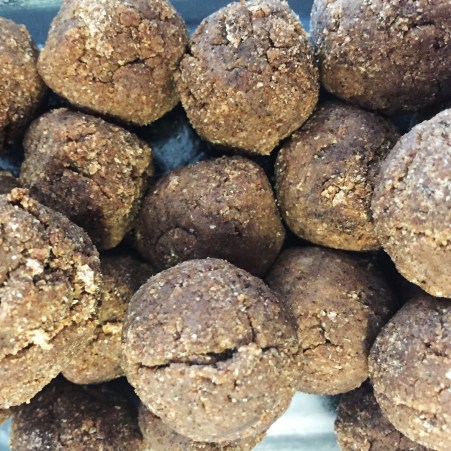
Balls of maza.

Barley is one of the most ancient crops known to humanity. It was the staple crop of Egypt and Mesopotamia as well as Greece, where it is referenced in some of the earliest written inscriptions. An example of the centrality of barley to the Greek diet can be found in the name of the Greek goddess of the harvest: Demeter, from dēa métēr, “Barley Mother”.

While various ancient cultures venerated barley, they differed in how they made use of it. Porridge is perhaps the simplest preparation, since it requires nothing more than whole grains, water and fire. There are numerous accounts of porridge throughout the ancient world, made from barley as well as other grains, and it likely dates back to humanity’s earliest farming days. Bread and beer are comparatively more complicated to produce and are therefore more recent innovations. While barley beer was cherished in Egypt and Mesopotamia, barley bread often had a lesser reputation. Barley is harder to refine into flour than other grains such as wheat, and barley bread (especially with the pre-Industrial technology of ancient times) arguably inferior to wheat bread, being more dense and less chewy. In Egypt and Mesopotamia alike, everyone drank barley beer and those who could afford it enjoyed wheat bread, while barley bread and porridge were staples of the lower classes.

The Greeks disdained beer as a drink for barbarians. They did make porridge and bread, and agreed with other ancient peoples that barley bread wasn’t really worth the trouble. But their preference was to serve barley in a unique form somewhere between porridge and bread; an intermediate recipe called maza (μᾶζα in Greek letters, and originally pronounced like “mahsdah”)

Maza begins as álphita: barley flour that has been toasted over a fire, giving it a dark brown color and a nutty aroma and flavor. This rich flour is mixed into a dough with hot water and a little bit of oil (and perhaps salt). No baking is required, as the flour has already been cooked. The maza is then shaped into balls or pancakes. Sometimes small maza dumplings were added to broth to create an ancient matzoh ball soup.

Maza is believed to date back to well before the emergence of a recognizable Greek civilization, and is referenced by very early Greek authors such as Archilochus above, who lived in the 600s BCE. Maza requires very little effort or technology to produce and is both nourishing and versatile. It should come as no surprise, then, that of the many ancient cultures who made use of barley, the Greeks were not the only ones who came up with this particular recipe. In Tibet, a very similar dish is called tsampa, and is such an important part of local culture even today that Tibetans sometimes refer to themselves as “tsampa-eaters”.

IMG_3157

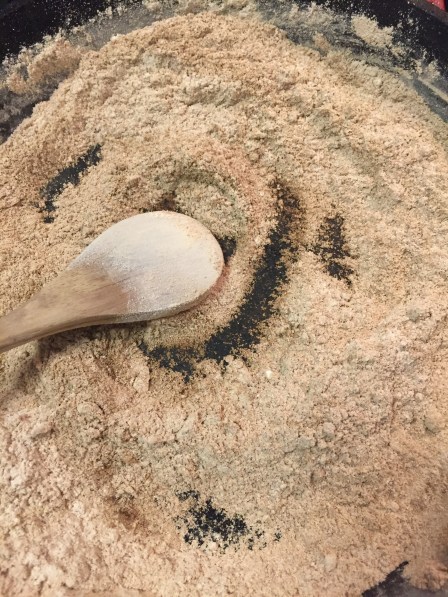
Your barley flour should look something like this when it’s ready to be mixed with water, salt and oil. Make sure you stir thoroughly to distribute the heat.


The Ancient Greeks prided themselves on a simple, hearty diet, believing it the source of their strength and, to some degree, their superiority. The varied cuisines of other peoples like the Persians were looked down upon as decadent, diet seen as evidence of moral character (“you are what you eat”). Maza has few ingredients, does not require much preparation, and is quite filling: thus, it checks off all the criteria of an ideal Greek staple.

In Greek dining, food was divided into two broad categories. Sitos was the grain–the bread, porridge or maza that formed the basis of the meal. In hard times sitos could be a meal on its own; in the play Eirēnē (“Peace”), Aristophanes describes a prisoner as “eating nothing but barley”, a Greek equivalent of our phrase “bread and water.” But most of the time, you would want your sitos with something tastier to go on top of it. This is where the other broad food category, opson, comes in. Opson was formerly translated into English as “relish“, but it covers a broad range of dishes, from vegetables and cheese to fish and meat. Containing ingredients that were more costly and less common overall, opson dishes were cherished and celebrated. The balance between richly flavored opson and bland sitos in the Ancient Greek meal calls to mind a similar concept in Japanese and Korean cuisines, where a varied assortment of dishes (called okazu and banchan, respectively) is served in small portions with rice.

THE RECIPE*

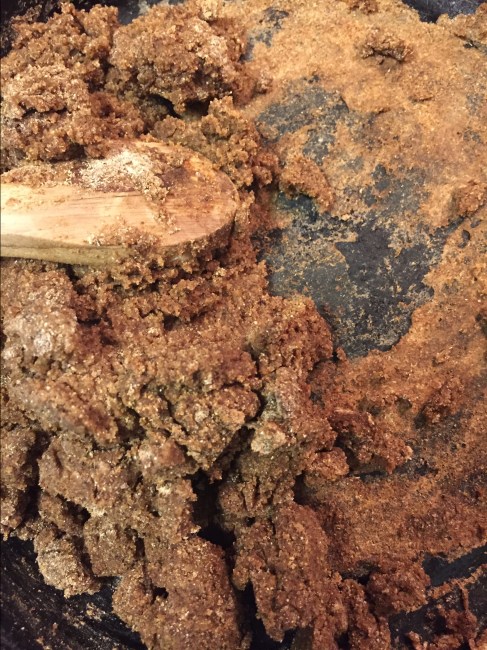
First, make your álphita. Pour 1 and 1/4 cups of barley flour into a skillet over medium-high heat.  Stir it thoroughly with a wooden spoon until it gives off a toasted aroma and turns a rich brown color. Then, remove from the heat and add 1/2 a cup of water, 2 tablespoons of olive oil and a pinch of salt. Continue stirring until you have an even, thick dough.

IMG_3159

Half-mixed maza dough.


You might need to add a little more water. Once your dough has cooled, you can shape it as desired. Note that it is not flexible enough to knead like bread dough.

Your maza is now ready to serve: make sure you have some opson ready!

THE VERDICT

Maza has a pleasant, nutty flavor, and I’ve especially enjoyed it with a simple spread of mashed olives, garlic, olive oil and minced herbs. I’m sure it would also be great with cheese or anything with a sauce that you might dip bread into. Just don’t overindulge in the delights of opson, lest you be branded a gluttonous opsophagos, literally “opson-eater.” Barley, the ancient mother that sustained the Greeks, is still pretty good on its own. VIII out of X.

*adapted from Cooking in Ancient Civilizations by Cathy Kaufman (2006)